Top Businesses In India

Over the last decade, many strong economic reforms are implemented by the govt of India. The introduction of GST and investor-friendly laws helped many industries to extend profit and for several to sustain. These favorable conditions are making India stand firmly during these critical financial conditions worldwide. Following are the ten leading industries in India, that are supporting our economy extensively:

Textile Industry
The Indian textile industry is one among the oldest industries that’s supporting the Indian economy. It can produce a good range of products for each segment in India and abroad. Scope of the industry composites of the generation of staple like silk, wool, and jute to process them to finished apparel. Moreover, the textile industry features a contribution of twenty-two in GDP and is playing a serious role by having a 15% share of the export earnings of India in 2018–19. Additionally, it provides job opportunities to around 4.5 million people across the country. The industry is currently estimated at US$250 billion.

Further, leading textile companies in India are Bombay Dyeing and Manufacturing Company Ltd., Fabindia Overseas Private Ltd, Grasim Industries Ltd, Vardhman Ltd, Raymond Ltd. Among promising start-ups in Industry, PostFold Ltd and IntelloCut are making commendable progress.

Pharmaceutical Industry:
India is that the favorite country in providing Generic Drugs globally. It supplies around 50% of vaccines worldwide. Additionally, it values US$ 55 billion. Further, it recorded a 9.7 to extend in export earnings of India whereas it’s a 2% share in GDP.

Leading pharmaceutical companies in India are Piramal Enterprises, Sun Pharmaceutical Industries, Aurobindo Pharma Ltd, Dr. Reddy’s Laboratories, Wockhardt Ltd.

IT and Services:
Indian IT industry has its conveyance centers in many countries across the world . The IT sector in India has two components, information technology services, and BPO. Additionally, it’s increased its share in India’s GDP from 1.2% to 7.7% (as per fiscal year report of 2017–18). the price of the Indian ITeS industry is US$177 billion. 4.1 million people are employed in ITeS.

Top ITeS companies in India are TCS, Wipro, HCL, Tech Mahindra, Oracle Financial Services, Mphasis, etc. TCS may be a leading ITeS company with a market price of around US$100 billion.

Automobile Industry:
India is that the fourth largest company considering the car market recording sales of 26.27 million units in FY19. The Two-wheeler industry is more dominant than other segments of automobiles. India grabs 7th position in manufacturing automobiles. Increased specialise in the agricultural market is that the reason behind the expansion of the car industry. It contributes a 7% share within the GDP of India. the dimensions of the Indian industry is 2.6 million units. internet output from the industry is US$ 300 million.

Ashok Leyland, Bajaj Auto Ltd, Eicher Motors Ltd, Force Motors Ltd, Mahindra & Mahindra Ltd, Hero MotoCorp Ltd, Tata Motors Ltd are the large names within the Indian automobile sector. Maruti Suzuki is that the biggest automobile manufacturer in India. It holds 53% of the market share.

Chemical & Petrochemical Industry:
The Indian chemical and petrochemical industry values US$ 118 billion. It shows the expansion rate of a CAGR of 8% for subsequent five years. it’s contributed a 9% share of total Indian export earnings. This sector holds a 15% share within the manufacturing GDP (during 2012–13). Bulk chemicals are the most important sub-segment of the Indian industry holding 40% market share whereas specialty chemicals with approximately 19% market share. Gujarat, Maharashtra, and Uttar Pradesh hold quite 50% of Gross Value Add (GVA) and Gross Output of the chemical and petrochemical industry.

Pidilite Industries Ltd, Tata Chemicals Ltd, UPL Ltd, Gujarat Fluoro Chemicals Ltd, Reliance Industries Ltd, Indian Oil Corporation, Manali Petrochemical Ltd, etc are the leading companies in Indian chemical and Petrochemical Industry. Reliance Industries rules the petrochemical market in India and abroad.

Engineering Industry:
Increased investments in infrastructure, industrial manufacturing, durables , automobile industries have also boomed the Engineering industry. This industry has strategic importance to India’s economy. Export of transport equipment, construction equipment, machinery, light engineering equipment has helped the Indian economy to realize growth. It holds a 60% share of total export. During FY 18–19, India exported US$81.02 billion engineering equipment. It showed a growth of 6.32%. Construction equipment shows the expansion of 18% in FY19 whereas electrical equipment recorded the very best growth of 12.8% during an equivalent period.

L&T Ltd, Tata Group, Reliance Industries, Godrej are the leading Indian engineering companies. L&T is that the principal ruling construction and engineering of India.

Financial Services:
Rising income has expanded the expansion of monetary Services in India. Commercial banks, insurance companies, NBFCs, etc come under Financial services. This industry has grown to US$376.73 billion by Oct 19. IPO showed rapid climb of US$2.10 billion in FY19.

Bajaj Finance Ltd, GIC Housing Finance Ltd, HDFC Ltd are the simplest financial service providers in India.

FMCG
FMCG is that the fourth prime sector within the Indian economy. It showed a growth of 16.5% in value terms. It grew 9–10% during FY19. the world is predicted to succeed in US$103.7 billion by FY20.

Godrej, Parle Agro Ltd, ITC Ltd, Marico Ltd, Amul are the leading FMCG companies in India.

Dabur India is India’s largest FMCG Company with revenues of over US$ 1.22 billion in FY19.

Education & Training Industry:
As India has the most important population aged group 5–24, apparently there are more opportunities for the education sector. Moreover, it had been worth US$101.1 billion in FY19. India has 39,050 colleges and 903 universities. Further, the Gross Enrolment Ratio for education was 25.8% in FY17–18. Moreover, the world is estimated to succeed in US$1.96 billion by 2021 with approximately 9.5 million users.

Some of the leading Indian companies within the sector are BYJU’s, Dexler Education, Educomp Solutions, IGNOU, NIIT, etc.

Tea Industry:
The tea industry plays an important role within the Indian economy. Moreover, the bulk of the tea comes from Assam and West Bengal . Additionally, India has maintained its leadership during this industry with a turnover of roughly Rs 10,000 crores. Further, India has increased tea production by 250% and land utilization for an equivalent by 40%. It contributes a 9.33% share in export earnings.

Therefore, Tata Tea, Bombay Burmah, Roselle India, Goodrick’s groups are the highest Indian companies who are tea manufacturers and exporters. Hence, Tata Tea is that the largest manufacturer and exporter of tea in India.


To know more, Click Here

The Process of Due Diligence Services in India

If you happen to be an entrepreneur or a sale one that has his/her sights on the acquisition of a business, it’s your right to examine the financial records, and research that’s company activity related. Due diligence services in India enters the image at now and ensures that related information is compiled. It also sees if there’s a minimum average which can influence your ultimate decision regarding the acquisition or purchase.

Due Diligence Steps

  • The Action Plan: all the parties who are concerned with the deal should agree on what information and issues got to be highlighted in order that due diligence is completed effectively. The ambit of the problems and knowledge may or might not include structures within the organization, annual legal reports, shareholding records, personal and company financial records.
  • Reviewing the finances: The Due diligence team makes it some extent to carefully undergo the balance sheets of the corporate additionally to annual reports and cash flows too. All the pertinent files are validated with the assistance of an accountant and therefore the tax office.
  • Asset inspection: If there’s a plant and machinery involved within the business, the due diligence team views them as assets, ensuring that each one of the above are in good working condition. A stock value is suggested before the day of settlement. Insurance plans and policies should even be checked beforehand.
  • Scale of prospects and therefore the supply chain: The Due Diligence Team requests the list of key clients to work out if they’re active buyers. Existing contracts should even be scanned to seek out out if future business is feasible . Suppliers also fall within the gaze of due diligence and that they are verified to ascertain if outstanding payments remain or if there are settlement invoices.
  • Level of the competition and reason for sale: As an investor, you’ll be benefited to understand the precise reasons behind the sale of the corporate . this may entail a touch of digging around and also observing the competition from other players in order that a benchmark are often determined. Industry trends should also not be neglected.

Audit under CFR regulations – Code of Federal Regulations

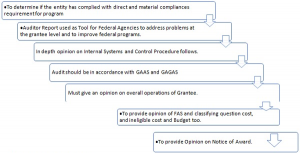
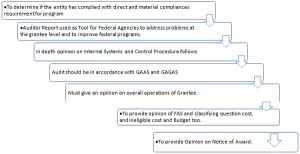
This Article talks about the overview for conducting audit as per Code of Federal Regulations CFR, standards for obtaining consistency and uniformity for the audit of Indian Government and Non-Government social bodies which are granted Aids by Government and Non-Government US agencies.

In context to audits for projects executed by Healthcare and Hospital ‘s related to Research of Antibiotics or Influenza of for any other disease or social cause, the Audit Report must be issued in accordance CFR and GAGAS. Report Emphasis on Fund Accountability Statement, internal controls, statutory compliance requirements, suggested audit procedures, management report and audit reporting requirements.

Social Agencies constantly work 24/7 to protect a nation from health, safety and security threats within and outside the country. Diseases start at home or other country, whether it is chronic or acute or curable or preventable or deliberate attack, it’s team which fights against the disease and supports communities and citizens to do the same.

In the case of US foreign GRANT to Non-Federal Agency where expend is US$ 750,000 or more during Non-Federal Agency Fiscal Year in federal Awards, then specific Audit under CFR needs to be conducted.

US federal and Non-Federal Agencies keep awarding project to different Indian organizations to help implement Global Health Security Agenda projects across the country. Project are mainly in the expansion of various disease detection networks, as well as provide resources needed to help strengthen India in overall preparedness for potential global disease threats like COVID 19 Corona Virus, EBOLA, INFLUENZA, Research on Antibiotic and much more.

In CFR Audit, Auditee responsibilities are:

Auditors Responsibility

Audit Report Submission

The audit must be completed, and the data collection form described in CFR. Audit Report must be submitted within the earlier of nine months after end of the audit period.

Federal Agency Responsibility:

Federal Agency provides technical audit advice and liaison assistance to auditee and auditors. Federal agency to advise auditee while procuring audit services, the objective is to obtain high quality audits. The objective of the audit and scope of the audit must be made clear and the non-federal entity must request a copy of the audit organization’s peer review report which the auditor is required to provide under GAGAS.

For more Details, Visit: https://pkchopra.com/blog/index.php/audit-under-cfr-regulations-code-of-federal-regulations/ 

Impacts of Covid-19 on Financial Reporting


INTRODUCTION
COVID-19, an infectious disease caused by a novel Coronavirus is exponentially spreading illness and causing deaths to citizens throughout the globe and has been recognized as a global pandemic by the WHO. COVID-19 has not only affected the health of people across the globe and it has also caused severe disturbances in the global economic environment which has consequential impact on financial statements and reporting.

The adverse impact of this global pandemic can vary from nation to nation, industry to industry and above all entity to entity. As the companies in India approach their year-end, there is an urgent need to evaluate the impacts of the outbreak on their accounting and financial reporting. In this regard ICAI issued an advisory to provide light on some important requirements of Indian Accounting standards (IND AS) and Accounting standards (AS) to be considered by preparers of financial statements on how to incorporate effect of COVID 19 on financial statements for the year ending 31/03/2020.

Some of the key accounting and financial reporting considerations for the companies are explained below.

1. GOING CONCERN ASSESSMENT
The Financial statements are normally prepared on the assumption that an entity is a going concern and will continue in operation for the foreseeable future. In this regard Management would need to assess whether the current events and conditions cast significant doubt on the company’s ability to continue as a going concern.

While assessing that whether any entity is going concern or not, management should consider all available information about future for at least the period of next 12 months from the end of reporting period. If management decides that due to impact of COVID 19 entity intends to liquidate the entity or cease its business after the end of reporting period, then accounts shall not be prepared on going concern basis. Necessary disclosures as per Accounting Standards shall also be made, such as material uncertainties that might cast significant doubt upon an entity’s ability to continue as a going concern.

2. INVENTORY MEASUREMENT
Due to COVID 19 there is a decline in sales, decline in selling price which might lead to obsolescence of inventory and reduction in movement of inventory. Hence management are advised to consider writing off inventory to its Net Realisable Value i.e. NRV. Accounting Standards also provide light on allocation of fixed production overheads on the basis of normal production capacity. The amount of fixed overhead allocated to each unit of production is not increased as a consequence of low production or idle plant. Unallocated overheads are recognised as an expense in the period in which they are incurred.

All organizations are required to assess the disclosures due to write down of inventory as per applicable Accounting Standards.

3. LEASES
(a) If there are any revision in lease terms and agreement due to COVID 19 such as concession with respect to lease payments etc, these revisions must be incorporated. (anticipated revisions are not to be incorporated).

(b) Discount rate used to determine the present value of new lease liabilities may need to incorporate any risk associated with COVID-19.

(c) If Government grant any compensation to lessor in order to provide concession to lessee. It is advised to consider whether same is to be accounted for as lease modification under IND AS 116 or whether consider assistance received from government as grants under IND AS 20.

(d) Check whether discount rate used to discount value of lease liabilities include the effect of risk of COVID 19.

(e) Check whether any lease contracts have become onerous due to COVID 19.

All the entities on whom AS 19 is applicable need to examine all the same situations as mentioned in IND AS 116 but with respect to AS 19. If any contracts have become onerous, such contracts need to be accounted under AS 29.

4. REVENUE
Entities may have to disclose any impact of COVID 19 on nature, amount, timing and uncertainty of revenue as per applicable Accounting Standards. When estimating the amount of revenue to be recognized, factors like increase in sale return, high price discounts etc due to COVID 19 need to be considered. Also, they should consider related impact on recoverability of trade receivables including estimate of expected credit losses.

Such entities might need to defer the recognition of revenue due to collection uncertainty as a result of impacts of COVID 19. Disclosure of such deferment shall also be made according to AS 9.

5. PROVISIONS, CONTIGENT LIABILITIES AND CONTIGENT ASSETSEntities covered under IND AS 37

(a) Some contracts are bound to become onerous due to COVID 19. If any such contracts are found they should be recognized as per IND AS 37. Before recognizing onerous contract, all assets dedicated to such contracts should be tested for impairment. (Onerous contracts are those contracts in which unavoidable cost of meeting obligation is more than the benefit to be achieved from the contract). It is also advised to disclose if any executory contracts are converted to onerous due to impacts of COVID 19.

(b) Insurance claims may be recorded by entities only if the insurance companies have accepted the claim and recovery is virtually certain.

Due to COVID 19, judgement need to be applied in ascertaining provisions for losses and claims.

Entities covered under AS 29
If any contracts are converted into onerous due to COVID 19, then such contracts need to be recognized as per AS 29. If any executory contracts are converted into onerous then such contracts shall be disclosed. If management in unable to analyse whether executory contract is converted to onerous or not due to unavailability of information, then such contracts shall be disclosed as well.

6. INCOME TAXES
COVID-19 could affect future profits and/or may also reduce the amount of deferred tax liabilities and/or create additional deductible temporary differences due to various factors. Entities with deferred tax assets should reassess forecasted profits and the recoverability of deferred tax assets in accordance with Ind AS or AS as applicable on entity, considering the additional uncertainty arising from the COVID-19 and the steps being taken by the management to control it.

7. PROPERTY PLANT AND EQUIPMENT (PPE)Ind AS 16 and AS 10 require that useful life and residual life of PPE needs revision in annual basis. It may be noted that the standards require depreciation charge even if the PPE remains idle. Further, COVID-19 impact may have affected the expected useful life and residual life of PPE.

The management may review the residual value and the useful life of an asset due to COVID-19 and, if expectations differ from previous estimates, it is appropriate to account for the change(s) as an accounting estimate in accordance with Ind AS 8 or AS 5 whichever applicable on the entity

8. POST BALANCE SHEET EVENTS
Entities must disclose significant recognition and measurement uncertainties that might have been created by the outbreak of the COVID -19 in measuring various assets and liabilities. They should also disclose how they have dealt with the impact of COVID -19 on the financial position and financial performance of the entity.

Spending of CSR funds for COVID-19 is an eligible ‘CSR activity’

Keeping in view the spread of novel Coronavirus in India, its declaration as pandemic by WHO, and decision of Government to treat it as notified disaster, it has been clarified that spending of CSR funds by companies for COVID-19 cause shall be eligible CSR activity under Companies Act, 2013. Funds may be spent for various activities related to COVID-19 relating to health care, including preventive health care and sanitation, and disaster management.

Supreme Court extends limitation for filing appeals until further order
The Apex Court by taking suo-moto cognisance of situation faced by country on account of Covid-19 pandemic has indefinitely extended the ‘limitation period’ for filing appeals against orders of High Courts or any Tribunal to Supreme Court. To obviate such difficulties and to ensure that lawyers/litigants do not have to come physically to file such 2 proceedings in respective Courts/Tribunals across the country including this Court, it is hereby ordered that a period of limitation in all such proceedings, irrespective of the limitation prescribed under the general law or Special Laws whether condonable or not shall stand extended w.e.f. 15th March 2020 till further order/s to be passed by this Court in present proceedings.

Sebi further relaxes compliance norms for listed entities
SEBI, vide circular no SEBI/HO/CFD/CMD1/CIR/P/2020/38 dated March 19, 2020 had provided relaxation from compliance with certain provisions of the LODR. It has been decided to grant the following further relaxations from the LODR.
Regulation and associated filing:
1. Regulation 40(9) relating to Certificate from Practicing Company Secretary on timely issue of share certificates (half yearly): Extended to May 31, 2020
2. Regulation 44(5) relating to holding of AGM by top 100 listed entities by market capitalization for FY 19–20 (annual) : Extended to September 30, 2020

Bill for direct overseas listing of firms tabled
The Centre has introduced the Companies Amendment Bill 2020 in the Lok Sabha to decriminalise procedural and technical lapses and to allow direct listing of securities by Indian firms in permissible foreign jurisdictions.
The Bill has also laid down rules for incorporation, registration, amalgamation, and functioning of producer companies, apart from paving the way for conversion of interstate cooperatives into producer companies.
The proposed amendment is in line with the government´s aim to streamline the functioning of farmer producer organisations in order to achieve the goal of promoting 10,000 new FPO in the next five years.
A host of activities have been included into the ambit of producer companies that include financing the need of primary producers largely farmers.

Labour Ministry amends EPF norms in event of Covid-19 outbreak
The notification GSR 225(E) issued by Ministry of Labour and Employment amending the EPF Scheme 1952 allows withdrawal of non-refundable advance by EPF members in the wake of COVID -19 pandemic in the country. The notification permits withdrawal not exceeding the basic wages and dearness allowance for three months or upto 75% of the amount standing to member’s credit in the EPF account in the event of outbreak of epidemic or pandemic.

FM announces Rs 1.70 Lakh Cr. relief package for poor to fight battle against Corona Virus
The Union Finance & Corporate Affairs Minister Smt. Niramla Sitharaman today announced Rs 1.70 Lakh Crore relief package under Pradhan Mantri Garib Kalyan Yojana for the poor to help them fight the battle against Corona Virus. While addressing the press conference here today, Smt. Sitharaman said “Today’s measures are intended at reaching out to the poorest of the poor, with food and money in hands, so that they do not face difficulties in buying essential supplies and meeting essential needs.”

Detailed comparison of CARO 2016 with CARO 2020

In pursuance of its objective of strengthening the corporate governance framework under the Companies Act, 2013 to attain the national objective of becoming a $ 5 Trillion economy, powers conferred under sub-section (11) of section 143 of the Companies Act, 2013 and in supersession of the Companies (Auditor’s Report) Order, 2016, the Central Government has notified the Companies (Auditor’s Report) Order, 2020 (CARO 2020) on 25th Feb, 2020.

The CARO, 2020 is applicable for an audit of financial statements of eligible companies for the financial years commencing on or after the 1st April 2019. The criteria of eligibility of companies on which the CARO, 2020 shall be applicable has not been changed and hence it shall be applicable to all those companies on which CARO, 2016 was applicable. CARO 2020 would necessitate enhanced due diligence and disclosures on the part of auditors of eligible companies and has been designed to bring in greater transparency in the financial state of affairs of such companies.

The CARO, 2020 includes certain additional clauses, as compared to CARO, 2016, and the existing clauses of CARO, 2016 have been re-drafted to elicit detailed comments from the auditors. A brief analysis is given below:

1. Fixed Assets:

  • In clause (i)(a): The word “Fixed assets” is replaced by “Property, Plant and Equipment” and “Intangible asset” separately.
  • New clause (i)(a)(B) has been inserted to report whether proper records have been maintained showing full particulars of intangible assets.
  • New clause (i)©: A specific format has been provided for reporting the details of such immovable properties (other than properties where the company is the lessee and the lease agreements are duly executed in favor of the lessee) whose title deeds are not held in the name of the company but are disclosed in the financial statements.

Description of propertyGross carrying valueHeld in the name ofWhether promoter, director or their relative or employeePeriod held — indicate range, where appropriateReason for not being held in the name of the company

  • New clause (i)(d): will be applicable if there is revaluation of fixed asset by registered valuer. Amount to be specified if deviation is 10% or more.
  • New clause (i)(e): Disclosure of details of proceedings against the company for holding Benami Property and whether the company has disclosed the details in its financial statements.

2. Inventory

  • Clause (ii)(a) Expanded: Auditor is required to comment on coverage and procedure of inventory verification by management.

Also Materiality has been defined as 10% or more in each class of Inventory.

  • New clause(ii)(b): If the company has any working capital facility against current assets in excess of Rs. 5 crores at any time during the year, then the auditor has to confirm whether the quarterly submissions made to the lenders are in conformity with the books of accounts or not.

3. Loans granted

  • Modified clause(iii) of CARO, 2020: Details of all loans granted, advances in the nature of loans granted, guarantees/ security given to any entity has to disclosed. This will not be applicable to companies whose principal business is to give loans.
  • Details of loans which were renewed, extended or fresh loans are granted to settle overdue of existing loans given to same parties to be given. Inter alia percentage of such loans to aggregate loans granted is also to be given.
  • Details of all loans or advances which are repayable on demand or without any stipulated period of repayment has to be disclosed.

4. Loans, investments, guarantees, and security (Section 185 and 186 of Companies Act, 2013) : There is no change in CARO 2016

5. Deposits: There is no change in CARO 2016

6. Cost records: There is no change in CARO 2016

7. Statutory Dues: There is no change in CARO 2016

8. Default in repayment of loan or borrowings:

  • Modified clause (ix)(a): Defaults in repayment of principal or interest portion of ANY loan or other borrowings are now to be reported. Earlier defaults in loans from specified lenders like financial institutions, banks, Government or debenture holders were to be reported.

A specific format below has been prescribed to report the period and the amount of default by the company in repayment of loans or other borrowings or in the payment of interest thereon to any lender:

Nature of borrowing including debt securitiesName of lenderAmount not paid on due dateWhether principal or interestNo. of days delay or unpaidRemarks, if any

  • Newly inserted:
  • Clause(ix)(b): Auditor has to report if the company is declared a WILFUL DEFAULTER by the bank, financial institution or any other lender.
  • (ix)© Auditor to report whether term loans are applied for the purpose for which they were obtained
  • (ix)(d) Auditor to report if funds raised for short term have been utilized for long term purposes.
  • (ix)(e) If the company has taken any funds on account of meeting the liabilities of subsidiaries, joint ventures or associates, then such transaction details are to be reported.
  • (ix)(f) Auditor to report if the company has availed loans on pledge of securities held in its subsidiaries, joint ventures or associates.

9. Public offer: Clause (xiv) of CARO 2016 regarding preferential allotment of shares has been merged in clause (x)(a) of CARO 2020

10. Fraud by/on company: Modified Clause (xi)

(a) Earlier, auditor had to report on any fraud on the company done by its officer or employee. This specification has been removed. Now ANY fraud by the company or on the company has to be reported by the auditor.

(b) If any reporting of fraud has been filed by the auditor under 143(12) of the Companies Act, 2013 then such reporting has to be disclosed here also.

© Auditor has to disclose if he considered any whistle blower complaint received by the company during the year.

11. Managerial Remuneration: Clause (xi) of CARO 2016 has been removed in CARO 2020.

12. Nidhi Company: Defaults in repayment of principal or interest portion of deposits now to be reported in newly inserted clause (xii)©

13. Related Party Transactions: There is no change in CARO 2016

14. Internal Audit: New clause(xiv) inserted under which auditor has to report whether-

(a) Company has internal audit system commensurate to the size of the company.

(b) Such internal audit report has been considered by the auditor to reach his Opinion

15. Non-cash Transactions: There is no change in CARO 2016

16. RBI Registration: New clause (xvi) has been inserted in CARO 2020. Accordingly, auditor has to comment if the company has done any NBFC activity without valid registration from RBI.

Whether the company is fulfilling the criteria of Core Investment Company (CIC) or exempted CIC, is to be reported by the auditor

If the company has more than one company as part of the group, then the number of CICs which are part of the group are to be reported.

17. Cash losses: New clause (xvii) has been inserted in CARO 2020.

If the company has incurred cash losses for 2 consecutive years, then the amount of such cash losses are to be reported.

18. Resignation of auditor: Newly inserted clause (xviii)

The current auditor to report if he has taken into consideration the issues, objections or concerns raised by the outgoing auditor, in case the outgoing auditor had resigned during the year.

19. Material uncertainty: Newly inserted clause (xix)

Auditor has to comment whether material uncertainty with regards to company meeting its liabilities is existing at the Balance Sheet date as and when they fall due for the next one year on the basis of:

(a) Financial ratios

(b) Ageing & expected realization dates of financial assets & liabilities

© Other information accompanying the financial statements

(d) Knowledge of the Board and Management Plans

20. Corporate Social Responsibility: Newly inserted clause (xx) regarding transfer of unspent CSR funds to a specified fund within 6 months from the expiry of the F.Y. is to be reported.

21. Qualifications or adverse remarks by auditor in CFS: clause(xxi)

Auditor has to report whether there have been any qualifications or adverse remarks by the respective auditors in the Companies (Auditor’s Report) Order (CARO) reports of the companies included in the consolidated financial statements and details of those companies thereof.

Closing Thoughts

The CARO, 2020 is expected to significantly improve the overall quality of reporting by the Auditors on the financial statements of the Companies and thereby lead to greater transparency and faith in the financial affairs of the companies. This is automatically expected to bring greater inflow of investment by and in Indian companies.

Income Tax Audit in India | Due Diligence Services in India

E-FRRO compliance for foreign nationals in India

Under Indian law, the legal rights and the restrictions imposed on foreign nationals depend on whether they are categorized as residents or non-residents.

Entry into India generally requires a valid visa granted by an Indian Mission (that is, consulate of the Indian embassy) abroad. Furthermore, foreign nationals who enter India must register themselves with the Foreign Regional Registration Office (FRRO) within 14 days of arrival if they intend to reside in India for a consecutive period of more than 180 days.

The entry, stay and exit of foreign nationals into India are primarily governed by the following laws (among others):

  • Passport (Entry into India) Act 1920, read with the Passport (Entry into India) Rules 1950.
  • Foreigners Act, 1946.
  • The Registration of Foreigners Act 1939, read with the Registration of Foreigners Rules 1992.

What is e-FRRO?

  • It is web-based application aimed to build centralized online platform for foreigners for visa related services. Its key objective is to provide Faceless, Cashlessand Paperless services to the foreigners with user friendly experience.
  • Using this application, foreigners are required to create their own USER-ID by registering themselves. Afterwards, they would apply online through registered user-id for various Visa and Immigration related services in India viz. Registration, Visa Extension, Visa Conversion, Exit Permit etc, without any hassle and obtain the service(s) without coming to FRRO office.
  • The necessary immigration/Visa document e.g. Registration Permit/Certificate (RP/RC), Visa Extension Certificate etc will be sent by post on the address mentioned. It would also be electronically sent to the foreigner to his registered email ID.
  • Foreigners would not be required to mandatorily visit FRRO/FRO office for grant of service. However, in certain exceptional cases, the foreigner will be intimated to visit the FRRO/FRO on scheduled date and time for interview.
  • In case of an exigency, the foreigner can visit the FRRO/FRO office directly for grant of service.

Foreigners’ Registration in India

  • All foreigners (including foreigners of Indian origin) visiting India on long term (more than 180 days) Student Visa, Medical Visa, Research Visa and Employment Visa are required to get themselves registered with the Foreigners Regional Registration Officer (FRRO)/ Foreigners Registration Officer (FRO) concerned having jurisdiction over the place where the foreigner intends to stay, within 14 days of arrival (except Pakistan and Afghanistan).
  • All Business Visa holders are required to register themselves with the FRRO/FRO concerned in case the aggregate stay in India on Business visa exceeds 180 days during a calendar year.

Foreigners other than those mentioned above will not be required to get themselves registered, even if they have entered India on a long term visa provided their continuous stay in India does not exceed 180 days. If the intention of the foreigner is to stay in India for more than 180 days, he/she should get himself/ herself registered well before the expiry of 180 days from the date of arrival with the FRRO/FRO concerned.

Children below 16 years of age are exempted from Registration if they have entered on PIO card or on any type of Visa and except where specified otherwise. It is mandatory for all foreigners to personally appear at the concerned FRRO office for obtaining any Visa related services.

Requirements for Extension of Visa
Foreigners must submit application for extension of residential permit/ visa at least 60 days before the date of expiry of respective residential permit/visa.

Over stay
In the event of overstay foreigner is liable for prosecution under Foreigners Act 1946 and imprisonment up to 5 years with fine & expulsion from India.

Late Renewal of Residential Permit
A foreigner who has delayed for renewal of RP, on application, if delay is condoned will be charged a penalty in Indian currency equivalent to US $30/- for late renewal.

Report of absence from Registered Address
If at any time a foreigner proposes to be absent from his / her registered address for a continuous period of eight weeks or more or change his / her registered address, then the foreigner is required to inform in person or through an authorized representative or by registered post to his / her Registration Officer of his / her intention to change his registered address or to leave either temporarily or permanently under the jurisdiction of the Registration Officer. In case of return, the foreigner should inform the Registration Officer of the date of return and in case the foreigner is moving away inform the change of address. Any changes made subsequently should also be intimated to the Registration Officer. Every foreigner, who stays for a period of more than eight weeks at any place in any district other than the district in which his / her registered address is situated, shall inform the Registration Officer of that district of his / her presence. This can be made in writing and the requirements deemed to have been fulfilled if, prior to arrival the foreigner furnishes to the Registration Officer of the said district intimating the dates of his proposed arrival and departure from the district.

Change in Registered address
A foreigner shall be deemed to have changed his registered address, if he changes his residence from one place to another place in India and if having no residence, he leaves his registered address knowing that he is not likely to return within six months of leaving it.

Reports of other changes except address
Every foreigner is required to furnish to the Registration Officer of the district in which his registered address is situated, particulars of any circumstances affecting in any manner the accuracy of the particulars recorded in his certificate of registration within fourteen days after the circumstance has occurred, and generally shall provide to the Registration Officer all information as may be necessary for maintaining the accuracy of the certificate.

Surrender of certificates of registration on departure
Every foreigner who is about to depart finally from India shall surrender his certificate of registration either to the Registration Officer of the place where he is registered or of the place from where he intends to depart or to the Immigration Officer at the Port/Check post of exit at the time of final departure from India. If the certificate is surrendered other than to the Immigration Officer of the port or check post of exit, a receipt indicating such surrender of the document may be obtained and shown to the Immigration Officer at the time of final departure

Duplicate certificate of registration
If any certificate of registration, issued under existing Acts / Rules is lost or destroyed, the foreigner to whom it was issued, shall make or send to the Registration Officer of the district of his registered address a report of circumstances in which it was so lost or destroyed along with an application in writing and a copy of police report in order to issue a duplicate copy of the certificate of registration.

Person of Indian Origin (PIO)

  • As per the Gazette of India (Part-I, Section-I) published on 09.01.2015, all the existing Persons of Indian Origin (PIO) card holder registered as such under new PIO Card scheme 2002, shall be deemed to be Overseas Citizens of India Cardholder.
  • All PIO card holders with valid PIO cards as on 09.01.2015 are advised to apply for conversion of their PIO card to OCI card.
  • Bureau of Immigration would accept PIO card as valid document till March 31, 2019 along with valid foreign passport. Machine-readable electronic document is mandated by the International Civil Aviation Organization (ICAO) guidelines.

Overseas Citizen of India (OCI) Cardholder
(a) The following categories of persons (except Pakistan and Bangladesh) are eligible to apply under OCI scheme:

  • Who is a citizen of another country, but was a citizen of India at the time of, or at any time after, the commencement of the constitution; or
  • Who is a citizen of another country, but was eligible to become a citizen of India at the time of the commencement of the constitution; or
  • Who is a citizen of another country, but belonged to a territory that became part of India after the 15th day of August, 1947; or
  • Who is a child or a grand-child or a great grandchild of such a citizen; or

(b) A person, who is minor child of a person mentioned in clause (a); or

© A person, who is a minor child, and whose both parents are citizens of India or one of the parents is a citizen of India; or

(d) Spouse of foreign origin of a citizen of India or spouse of foreign origin of an Overseas Citizen of India Cardholder registered under section 7A, Citizenship Act 1955and whose marriage has been registered and subsisted for a continuous period of not less than two years immediately preceding the presentation of the application under this section.

Foreigners Possessing Entry (X) Visa / Journalist (J) Visa

  • Foreigners visiting India on long term Entry(X) visa or J visa would not require registration with the concerned FRROs/FROs if the duration of his/her stay does not exceed 180 days on a single visit. In case a foreigner intends to stay for more than 180 days on a single visit he should get himself registered well before the expiry of 180 days.
  • Foreigners visiting India are also required to adhere to the Special Endorsement made on the Visa by the Indian Mission.
  • Every foreigner at the time of Registration, shall furnish, such information in registration report, as may be in his possession for the purpose of satisfying the Registration Officer and shall, on being required, shall sign the registration report in the presence of the said officer and shall thereupon be entitled to receive from the said officer a certificate of registration in Part III of Form A.

Indians visiting abroad
ECNR/ECR
As per the Emigration Act, 1983, Emigration Check Required (ECR) categories of Indian passport holders, require to obtain “Emigration Clearance” from the office of Protector of Emigrants (POE), Ministry of Overseas Indian Affairs for going to following 18 countries.

United Arab Emirates (UAE), The Kingdom of Saudi Arabia (KSA), Qatar, Oman, Kuwait, Bahrain, Malaysia, Libya, Jordan, Yemen, Sudan, Afghanistan, Indonesia, Syria, Lebanon, Thailand, Iraq (emigration banned).

However , the Ministry of Overseas Indian Affairs (Emigration Policy Division) have allowed ECR passport holders traveling abroad for purposes others than employment to leave the country on production of valid passport, valid visa and return ticket at the immigration counters at international airports in India w.e.f. 1st October 2007.

If the RPO has issued Indian passport either with endorsement of “Emigration Check Required” or no endorsement of “Emigration Check Required” in the passport, POE clearance is required only when there is “Emigration Check Required” endorsement in the passport.

Auditing services in India

Stock Audit in India

Stock audit is a region of specialization and core competence for PK Chopra & Co. . Internal Audit Services are our greatest due to our unparallel reach and every one India network. Assets e.g. Stocks and physical assets like raw materials are important real assets and wish repeat watch. As a large number of companies are operating across the borders through multiple locations, some even with various channel partners, ensuring this watch is challenge. we provide our focused services to companies to stay them assured of their physical assets.

In other words, stock audit may be a statutory process which each business institution must perform a minimum of once during a fiscal year . As far the stock audit process cares , the method mainly involves the counting of physical stock presenting the required premises and verifying an equivalent with computed stock maintained by the corporate . the rationale and purpose behind executing this is often to correct the discrepancies present within the book stock in comparison to physical stock by passing necessary adjustment entries.

Fixed Assets Audit in India

Fixed assets are the long term assets that record within the record and showing balance at the top of the reporting date. Fixed assets are non-current assets that have a useful life for quite one years.

Fixed assets aren’t recognized as expenses within the earnings report at the time of buying but it’s recognized as expenses when the entity uses them.

Fixed assets are normally large if we compare to other assets like current assets. and that they are generally considered as sensitive areas from the audit perspective. The auditor responsible on these areas should be the one that has experiences and knowledge enough otherwise the detection or audit risks could be increasing.

Major Tax Benefits for a salaried taxpayer

Salaried taxpayers form a major chunk of the overall taxpayers in the country and the contribution they make to the tax collection is quite significant. Income tax deductions offer a gamut of opportunities for saving tax for the salaried class. With the help of these deductions and exemptions prescribed under Income Tax Act, 1961, one could reduce his/her tax substantially.

In this article, we list some of the major deductions and allowances for the FY2019–20 available to the salaried persons, using which they can minimize their tax burden and plan their salary structure and savings accordingly.

A. Allowances (sec 10)
 
Allowances are part of salary given to employees to meet some particular requirements connected with the services rendered by the employee. They may be fully taxable, partially taxable or fully exempt.

♦ House Rent Allowance (HRA)
 
This component of salary helps take care of rent paid by an employee for the premises in which he lives. To be able to claim this deduction, it is essential that it forms a part of one’s salary. Amount paid as HRA can be claimed as tax exempt, subject to certain terms and conditions as below.

Least of the following is exempt:

  • Actual HRA Received
  • 40% of Salary (50%, if house situated in Mumbai, Kolkata, Delhi or Chennai)
  • Rent paid minus 10% of salary [* Salary= Basic + DA (if part of retirement benefit) + Turnover based Commission]

It is fully taxable, if HRA is received by an employee who is living in his own house or if he does not pay any rent. Further, it is mandatory for employee to report PAN of the landlord to the employer if rent paid is more than Rs. 1 lakh.

♦ Entertainment Allowance:
 It is taxable as salary income. In case of government employees, it is first added to salary and thereafter least of following is deductible from salary in respect of entertainment allowance:

  • Rs. 5,000/- or
  • 20% of Salary or
  • Amount of entertainment allowance

*Salary for this purpose excludes any allowance, benefit or other perquisites.

♦ Special Allowances: Under Special Allowances, allowances are divided in following two categories:

I) When exemption depends upon actual expenditure incurred by the employee (Official Allowances): In this category, allowances are exempt u/s 10 to the extent of amount of allowance is used for the purpose for which the amount is received. The amount of exemption under this category is least of following:

  • Amount of allowance; or
  • Amount used for the purpose for which allowance is given

On the above basis, exemption is available in case of the following allowances:

  • Travelling Allowance / Transfer Allowance
  • Conveyance Allowance
  • Daily Allowance
  • Helper/ Assistant Allowance
  • Research Allowance
  • Uniform Allowance

II) When exemption does not depend upon actual expenditure incurred by the employee (Special Allowances): In this category, the amount of exemption does not depend upon actual expenditure incurred by the employee but depends upon amount specified in the income tax rule in respect of concerned allowance specified under this category. Allowances received under this category exempt to the extent of lower of following:

  • The amount of allowance; or
  • The amount specified in the income tax rules

Such allowances are as below:

Children education allowance
 
An education allowance of Rs. 100 per month or Rs. 1,200 per annum per child (maximum of 2 children) paid to an employee by an employer is allowed as deduction from taxable income to the employee.

Hostel expenditure allowance
 
Hostel expenditure allowance of Rs. 300 per month or Rs. 3,600 per annum per child paid to an employee is also allowed as a deduction from taxable income towards meeting hostel expenditure for the child. This deduction is granted up to a maximum of 2 children for the employee.

An optimum salary structure is that which enables you to meet your day-to-day expenses while leaving sufficient money in your hands for long-term financial goals. Hence, in each individual case, you have to gauge whether the benefits offered by the employer holds value for you and accordingly, you should structure your salary package.

Leave Travel Allowance (LTA)
 An employer provides LTA to employees to help them meet travel expenses incurred for travel with family to any place in India. Exemption from tax is only for an amount equal to the cost of travelling the shortest distance to the destination whether by air, rail or recognized public transport system.

♦ Food coupons
 
Food allowance can be given by the employer through the provision of food at working hours or through pre-paid food vouchers/coupons. For instance, vouchers (not transferable) are tax-exempt to the extent of Rs 50 per meal.

Gifts or vouchers provided by employer
 
Gifts or vouchers given by an employer in cash or in kind are tax exempt up to Rs 5,000 per year.

Others
 Others
are Special Compensatory Allowance, Border/ Tribal Area Allowance, Compensatory/ Highly Active Field Area Allowance, High Altitude Allowance, Island Duty Allowance and Underground Allowance.

B. Deduction from salary (sec 16)

Standard Deduction:
 Rs. 50,000 or the amount of salary, whichever is lower

Entertainment Allowance
 
Entertainment Allowance received by the Government employees (Fully taxable in case of other employees)

Employment Tax/Professional Tax:
 Amount actually paid during the year is deductible. However, if professional tax is paid by the employer on behalf of its employee than it is first included in the salary of the employee as a perquisite and then same amount is allowed as deduction.

C. Perquisites (sec 17)
 
Perquisites are fringe benefits that are received over and above the salary as a result of their official position. This is taxed separately for accountability and taxability. They may be provided in cash or in kind. Perquisites may be fully taxable, partially taxable or fully exempt. They are discussed as below:

Rent free accommodation:
 
The rent free accommodation provided to employees by their employer is taxable. Since the employees are provided rent free accommodation, the amount of income accruing to them cannot be determined by them. Accordingly, there is prescribed manner for calculating income chargeable to tax as perquisite.

ESOP/ Sweat Equity Shares:
 
The Companies in appreciation of its employees or with an aim to achieve a particular objective grants an option to the employees to subscribe equity shares at nil value or at concessional rates than the current market prices to its workforce. If the employee exercises such option and subscribes to such shares at nil or concessional rates, then it forms part of perquisites.

♦ Employer’s contribution towards superannuation fund:
 
Employer’s Contribution up to Rs. 1,50,000/- is exempt in the hands of the employee. Employee’s Contribution to Superannuation Fund is allowed as deduction under Chapter VIA.

Interest free loan or Loan at concessional rate of interest:
 
The value of the benefit to the employee as a result of interest-free loan or concessional loan for any purpose provided to the employee or any member of his household is a taxable perquisite.

Payment by the employer in respect of an obligation of employee:
 
In this case, the amount is liable to be paid by the employee and the employer pays the same. However, if the employer pays taxes on behalf of employees on non-monetary perquisites provided to them, then such taxes are exempt in the hands of the employee.

♦ Others

  • Furnished accommodation in a Hotel
  • Motor Car / Other Conveyance
  • Supply of gas, electricity or water for household purposes
  • Services of a domestic servant including sweeper, gardener, watchmen or personal attendant
  • Education Facilities
  • Free food and beverages
  • Gift or Voucher or Coupon on ceremonial occasions or otherwise
  • Medical facilities in/ outside India

D. Retirement Benefits (sec 10(10))

♦ Gratuity

Gratuity is a payment received by an employee by his employer as a gratitude for the employee’s services to the organization. It is over & above normal salary & other retirement benefits received by an employee.

♦ Pension

Pension means the employer provides to the employee a fixed monthly amount after his retirement in consideration of past services. Pension can also be called as annuity.

It also covers pension underNational Pension System (NPS).

♦ Leave Encashment

In employment, the employer allows a few number of paid leaves to the employees. If the employee fails to take leaves, then the employer may allow him to either accumulate the leaves for future or lapse the leaves. If the employee does not take such leaves then the balance of leaves accumulates. On retirement, the employer pays to the employee the salary that would accrue to him on the accumulated leaves. This is known as leave encashment. Leave Encashment is also known as leave salary.

♦ Retrenchment Compensation

If the employer relieves an employee of his duties for reasons other than death, retirement or disciplinary action against the employee, then the employer is liable to compensate the employee. The compensation received is known as Retrenchment Compensation.

♦ Voluntary Retirement Receipts

Sum received by an employee who opts for a Voluntary Retirement Scheme is known as Voluntary Retirement Receipt. The employer provides such option to the employees in order to reduce his surplus workforce.

♦ Employees’ Provident Fund

It is a savings scheme wherein employer and employee contributes a certain amount of money every year and employee receives the cumulative amount of money on retirement. There are various types of Provident Funds:

  • Public Provident Fund (PPF)
  • Statutory Provident Fund
  • Recognized Provident Fund
  • Unrecognized Provident Fund

Maturity amount and interest earned are fully exempt from tax.

Major Tax Benefits for a salaried taxpayer

Inventory audit

Inventories are tangible property held for sale in the ordinary course of business, or in the process of production for such sale, or for consumption in the production of goods or services for sale, including maintenance supplies, consumable stores and spare parts meant for replacement in the normal course. Inventories normally comprise raw materials including components, work-in-process, finished goods including by-products, maintenance supplies, stores and spare parts, and loose tools.

Inventories normally constitute a significant portion of the total assets, particularly in the case of manufacturing and trading entities as well as some service rendering entities. Audit of inventories, therefore, assumes special importance.

ICAI Guidance Note on Audit of Inventories

The Guidance Note deals with procedures of the auditor in respect of audit of inventories. It outlines the peculiar features of inventories, which impact the audit procedures.

The following is a gist of the important aspects of audit of inventories covered by the Guidance Note:

  • Internal Control Evaluation: It involves segregation of incompatible functions, standard form for recording movement of inventory, cross checking of data generated by different departments. The auditor should also review specific controls over receipts, issues, physical inventories, and inventory records.
  • Verification: It is the management’s responsibility for physical verification. In carrying out an audit of inventories, the auditor is particularly concerned with obtaining sufficient appropriate audit evidence to corroborate the management’s assertions regarding the following:

Verification of inventories may be carried out by employing the following procedures:

  • Examination of Records: The extent of examination of records by an auditor with reference to the relevant basic documents (e.g., goods received notes, inspection reports, material issue notes, bin cards, etc.) depends upon the facts and circumstances of each case. The auditor may come across cases where the entity does not maintain detailed stock records other than the basic records relating to purchases and sales. In such situations, the auditor would have to suitably extend the extent of application of the audit procedures.
  • Attendance at Stock Taking: The need for auditor’s attendance at stock taking would depend upon his assessment of the efficacy of relevant internal control procedures. The procedures concerning the auditor’s attendance at stock-taking depend upon the method of stock-taking followed by the entity (i.e. Periodic or continuous method). The auditor should observe the procedure of physical verification adopted by the stock-taking personnel to ensure that the instructions issued in this behalf are being actually followed. He should also examine whether the entity has instituted appropriate cut-off procedures.
  • Confirmation from Third Parties: Where significant stocks of the entity are held by third parties, the auditor should examine that the third parties are not such with whom it is not proper that the stocks of the entity are held. The auditor should also directly obtain from the third parties written confirmation of the stocks held.
  • Examination of Valuation and Disclosures: The auditor should satisfy himself that the valuation of inventories is in accordance with the normally accepted accounting principles and is on the same basis as in the preceding year. The generally accepted accounting principles involved in the valuation of most types of inventories are dealt with in Accounting Standard (AS) 2, “Valuation of Inventories”, issued by ICAI. Also, he should examine the evidence supporting the assessment of net realizable value. The auditor should satisfy himself that the inventories have been disclosed properly in the financial statements.
  • Analytical Review Procedures: The following analytical review procedures may often be helpful as a means of obtaining audit evidence regarding the various assertions relating to inventories:

(i) reconciliation of quantities of opening stocks, purchases, production, sales and closing stocks;

(ii) comparison of closing stock quantities and amounts with those of the previous year;

(iii) comparison of the relationship of current year stock quantities and amounts with the current year sales and purchases, comparison of the composition of the closing stock, comparison of significant ratios relating to inventories, etc.

  • Work in Progress: the auditor has to carefully assess the stage of completion of the work-in-process for assessing the appropriateness of its valuation. For this purpose, the auditor may examine the production/costing records (e.g., cost sheets), hold discussions with the personnel concerned, and obtain expert opinion, where necessary.
  • Management Representations: The auditor should obtain from the management of the entity, a written statement describing in detail, the location of inventories, methods and procedures of physical verification and valuation of inventories. However, it does not relieve the auditor of his responsibility for performing audit procedures to obtain sufficient appropriate audit evidence to form the basis for the expression of his opinion on the financial information.
  • Documentation by the auditor: The auditor should maintain adequate working papers regarding audit of inventories. He should maintain on his audit file a summary of each inventory as also the details regarding the extent of his verification. The management representation letter concerning inventories should also be maintained on the audit file.

The nature, timing and extent of audit procedures to be performed is, however,
a matter of professional judgement of the auditor.

responsible for stock taking, illustrative letter of confirmation of inventories held by others, illustrative letter of confirmation of inventories held by the entity on behalf of others and an illustrative management representation letter for inventories.

Design a site like this with WordPress.com
Get started